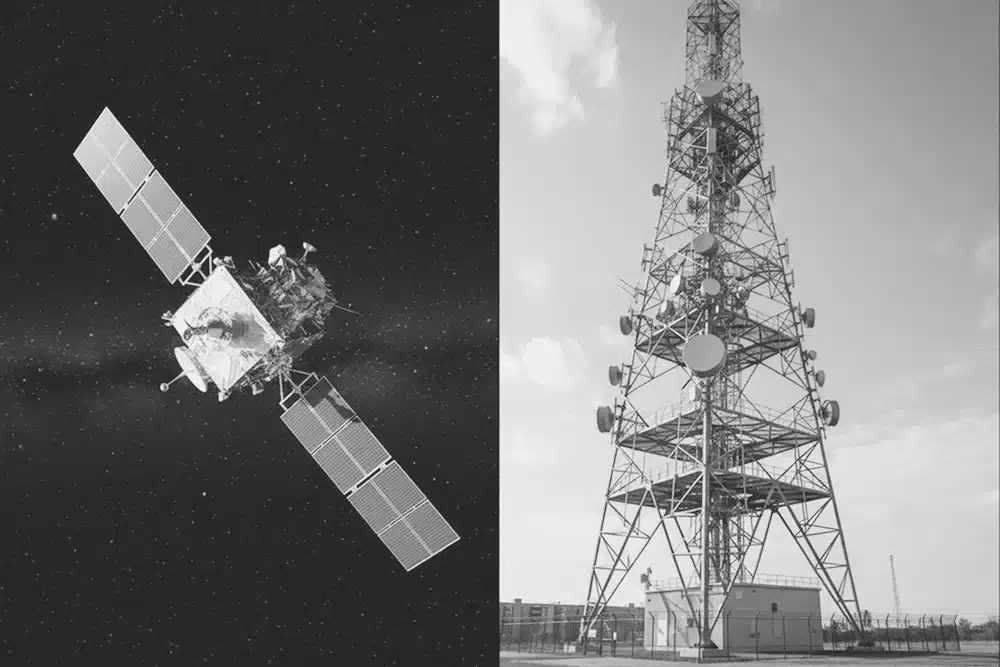
The rise of satellite internet and its emerging “sat-to-cell” capability has some US cell site owners asking, “Will these orbiting messengers replace traditional cell towers and sites?” As seasoned veterans with one of the largest portfolios of cell sites, we at TowerPoint know that technological advancements have historically had positive, rather than negative, impacts on existing infrastructure.
Here’s the reality: most high-quality cell sites will continue to play a crucial role in communications infrastructure for the foreseeable future. However, “sat-to-cell” deserves ongoing evaluation to understand potential risks and, more importantly, proactive strategies to navigate this evolving environment.
Satellites are not just here, there’s a lot more coming!
The satellite internet market size is poised for significant growth, with a projected 5x increase by 2030. This surge, coupled with near-universal geographic coverage, could impact traditional cell tower reliance, especially as satellite internet pricing and speeds become more competitive with terrestrial broadband. Currently, 2.5 million US consumers subscribe to satellite internet, despite higher costs and slower speeds than terrestrial broadband. And within 2 years, these limitations are expected to reach a turning point, potentially leading to a subscriber boom.
Differing Impacts: Rural vs. Urban
Satellites excel in covering remote areas where fiber is either absent or cost prohibitive. Though the federal government has earmarked billions of dollars in infrastructure spending to lay this fiber down, that is expected to take at least a decade, leaving a long window for satellites to leapfrog. And in the interim, the ability for satellites to provide coverage where cell tower construction is expensive or impractical could potentially reduce reliance on cell towers in sparsely populated regions.
In urban areas, satellites play a more complementary role by offloading data traffic from congested cell sites and improving network speeds. Think of them as capacity expanders, allowing the current infrastructure to handle more users, possibly offsetting or delaying expensive cell site upgrades.
But will this change the value of cell sites?
It depends. While overall demand might decrease slightly, the impact on individual sites will vary significantly depending on location and attributes.
Rural areas, where construction costs are high, could see a more dramatic decrease in cell site value as satellites offer a cost-effective alternative. This is particularly true in low-demand geographies, such as remote areas with challenging topography (e.g., mountain ranges), where laying fiber and building/maintaining a sufficient number of cell towers is cost prohibitive. Recognizing this shift, TowerPoint is proactively reducing exposure in these geographies to mitigate potential value decreases in those portions of our portfolio. However, individual site owners lack this geographic diversity and would be more directly impacted by any decline in cell site value.
On the other hand, this shift also presents a compelling opportunity. Proactive site owners with high-quality locations and capacity are well-positioned to capture new revenue streams from satellite integration.
The Bottom Line: Satellite risk may play a role, but it’s not the reason to sell your cell site.
Satellite technology is evolving, but it doesn’t mean selling your cell site. Its impact will vary based on your site’s unique characteristics. Regardless of location, a proactive understanding of “sat-to-cell” is key. TowerPoint can help:
- Assess the potential impact of sat-to-cell on your site’s value based on its location, attributes, and current tenants
- Identify strategies to mitigate risks
- Develop proactive strategies to maximize your site’s value potential